Every October, searches for a "Frida Kahlo rebozo" climb as people plan what to wear for Día de Muertos. It makes sense: few people are as closely tied to Mexican dress as Frida, and few garments are as recognizably Mexican as the rebozo. This guide covers what we actually know about Frida and her rebozos, how Día de Muertos is observed, and how to wear a rebozo for the season in a way that honors both, rather than treating them as a costume.
New to the garment itself? Start with our explainer, What is a rebozo?
What we know about Frida Kahlo and the rebozo
Frida Kahlo (1907–1954) built a public image around traditional Mexican clothing: long skirts, embroidered huipiles and fringed rebozos. That isn't legend. After her death, her clothes and personal objects were locked away at La Casa Azul, her home in Mexico City, now the Museo Frida Kahlo. They were opened in 2004, and the museum has shown her wardrobe since 2012 in the exhibition Appearances Can Be Deceiving. The museum lists "skirts, blouses, rebozos, headgear, shoes" among the pieces, and describes how through dress she revisited her family tradition, concealed her disability and built her iconic image.[1][2]
The Victoria and Albert Museum, which showed the collection in London, describes her wardrobe as including "rebozos (fringed shawls), embroidered huipiles (square-cut tops), enaguas (skirts) and holanes (flounces)," and calls her appearance "a political statement" of allegiance to Mexico.[3]
The single best-known image of Frida in a rebozo is a photograph: Frida with Magenta Rebozo, New York (1939) by Nickolas Muray, a color carbon print now in collections including the High Museum of Art in Atlanta.[4] It's worth looking at before you style your own, because it shows the shawl worn the everyday way: draped over the shoulders and arms, not pinned up as a prop.
For more on how Frida and other artists used the rebozo, see our culture post Famous Mexican Artists and Their Relationship with the Rebozo.
Día de Muertos: dates and traditions
Día de Muertos is not "Mexican Halloween." UNESCO, which inscribed Mexico's Indigenous festivity dedicated to the dead on its Representative List of the Intangible Cultural Heritage of Humanity in 2008 (it was first proclaimed in 2003), describes it as commemorating "the transitory return to Earth of deceased relatives and loved ones." It takes place from the end of October into early November, a period that also marks the end of the annual maize harvest cycle.[5]
The best-known days are November 1 and 2. Following the Catholic calendar, November 1 (All Saints' Day) is generally dedicated to children who have died, the muertos chiquitos, and November 2 (All Souls' Day) to adults. In some places, October 28 and October 30 are set aside for other groups of the dead.[6] Families scatter flower petals and set candles and offerings along the path from home to the cemetery, and prepare the departed's favorite foods for the home altar and the grave, among flowers and handmade objects such as cut-paper silhouettes.[7]
We already have a full post on the rebozo's place in the holiday itself: Exploring the Role of the Rebozo in Day of the Dead Celebrations. This guide is about the style side: what to wear, and how.
Wearing a rebozo for Día de Muertos, Frida-style
You don't need a costume to channel Frida. Her look was built from real garments, and a real handwoven rebozo is the piece that does the most work. A few principles:
1. Wear it the way she did: over the shoulders. Drape the rebozo across your back and let both ends fall forward over your arms, or cross one end over the opposite shoulder. That's the shape you see in the Muray portraits. For more drapes and knots, our main guide, How to Wear a Rebozo: Embracing Traditional and Modern Styles, walks through them step by step.
2. Choose color with intention. Frida's 1939 portrait is all deep magenta, and saturated color reads well for an evening at a cemetery vigil or a community altar. Strong reds, purples, pinks and golds sit naturally beside candles and flowers. A darker rebozo, such as black with gold, is a quieter choice if you're attending a family remembrance. Our post on color and pattern symbolism in Mexican rebozos goes deeper.
3. Build around it, not on top of it. A long skirt, a simple blouse and flowers in your hair are enough to suggest Frida's silhouette. Let the rebozo stay the main textile; you don't need face paint or a wig to make the reference clear.
4. Keep it practical. Late-October and early-November nights can be cool, and a cotton rebozo is genuinely warm. You can wrap it fully around your shoulders at the cemetery and loosen it indoors. That everyday usefulness is a big part of why the rebozo has lasted.
5. Respect the occasion. For many families, Día de Muertos is a time of mourning and remembrance as much as celebration. If you're joining a community event or visiting an altar, follow the hosts' lead. A rebozo is a respectful choice exactly because it's a real garment people wear, not a novelty.

"Rebozo costume"? Why a real rebozo beats one
Plenty of people search for a "rebozo costume" this time of year. Our honest advice: skip the printed polyester shawl. A handwoven cotton rebozo drapes and holds a knot in a way a thin costume scarf can't, and it doesn't end up in a drawer on November 3. It's the same piece you'll wear as a scarf all winter, and it can be used for pregnancy support or babywearing later. A season's outfit becomes something you keep.
If you're buying one as a present for someone who celebrates, our rebozo gift guide has more ideas.
In-stock rebozos for the season
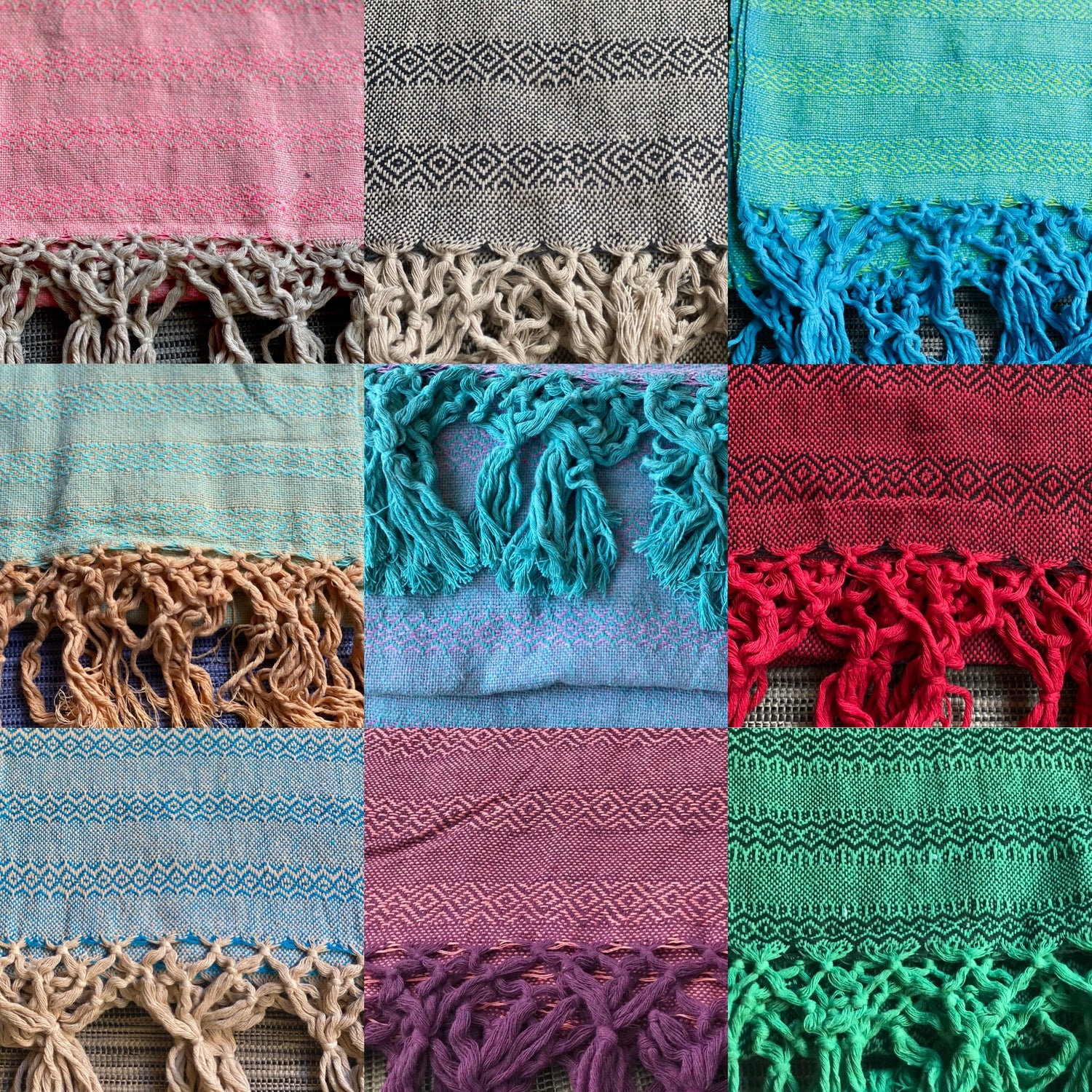
These colors suit the Día de Muertos palette, and all were in stock when we checked on October 22, 2026. Stock is limited, so availability can change quickly. See everything in the handwoven Mexican rebozo collection.
- Mole Dorado: deep burgundy with golden-yellow diamond stripes
- Chile Rojo: solid red with matching hand-knotted fringe
- Uva Morada: solid grape purple
- Tuna Rosa: hot pink with teal diamond stripes, the closest in our range to Frida's magenta
- Fire & Snow: bold red and white
- Noche de Mezcal: a dark, smoky black base with golden-tan and amber stripes, a quieter choice for remembrance

Frequently asked questions
Did Frida Kahlo really wear rebozos?
Yes. Rebozos are among the garments found in her wardrobe at La Casa Azul in 2004 and shown by the Museo Frida Kahlo, and Nickolas Muray photographed her in a magenta rebozo in New York in 1939.
When is Día de Muertos?
It runs from late October into early November. The main days are November 1, generally for children who have died, and November 2, for adults.
Is it respectful to wear a rebozo for Día de Muertos if I'm not Mexican?
A rebozo is an everyday Mexican garment, not a costume. Wearing a real, handwoven one with care, and following your hosts' lead at family or community events, is a respectful way to take part.
What color rebozo should I wear?
There's no single rule. Saturated reds, purples, pinks and golds suit the season's flowers and candles. A darker rebozo is a quieter option for remembrance.
Sources
- Museo Frida Kahlo, "Museum" / Appearances Can Be Deceiving: Frida Kahlo's Wardrobe. https://www.museofridakahlo.org.mx/museo/?lang=en
- Circe Henestrosa (curator), "Appearances Can Be Deceiving: The dresses of Frida Kahlo," Museo Frida Kahlo (PDF): wardrobe locked for 50 years and rediscovered April 2004. https://www.museofridakahlo.org.mx/wp/wp-content/uploads/2022/08/FKs-Dresses.pdf
- V&A, "Unlocking Frida Kahlo's wardrobe" (exhibition since 2012; rebozos listed). https://www.vam.ac.uk/articles/unlocking-frida-kahlos-wardrobe
- High Museum of Art, Frida with Magenta Rebozo, New York, Nickolas Muray, 1939, carbon print, acc. 2015.369. https://high.org/collection/frida-with-magenta-rebozo-new-york/ (also Tate: https://www.tate.org.uk/art/artworks/murray-frida-with-magenta-rebozo-new-york-x102203)
- UNESCO ICH, "Indigenous festivity dedicated to the dead" (inscribed 2008, proclaimed 2003). https://ich.unesco.org/en/RL/indigenous-festivity-dedicated-to-the-dead-00054
- UNESCO, "El Día de Muertos: el regreso de lo querido" (Nov 1 muertos chiquitos, Nov 2 adults; Oct 28/30 in some places). https://www.unesco.org/es/articles/el-dia-de-muertos-el-regreso-de-lo-querido
- Secretaría de Cultura, Sistema de Información Cultural, "Las fiestas indígenas dedicadas a los muertos." https://sic.cultura.gob.mx/ficha.php?table=otra_declaratoria&table_id=3