If you want to know how to tie a rebozo scarf, start with the shape. A rebozo is a long, flat rectangle with knotted fringe at both ends, so the same cloth can sit around your neck like a scarf or fall over your shoulders. This guide walks through six everyday rebozo knots and drapes. For shawl, waist, and warm-weather styles, see more ways to drape and style a rebozo. There's more on how rebozos are made and worn.
Mexico's National Institute of Indigenous Peoples notes that the word rebozo itself points to the act of covering yourself with the cloth. The steps below are practical everyday ties, not a list of named historic techniques.
What you need
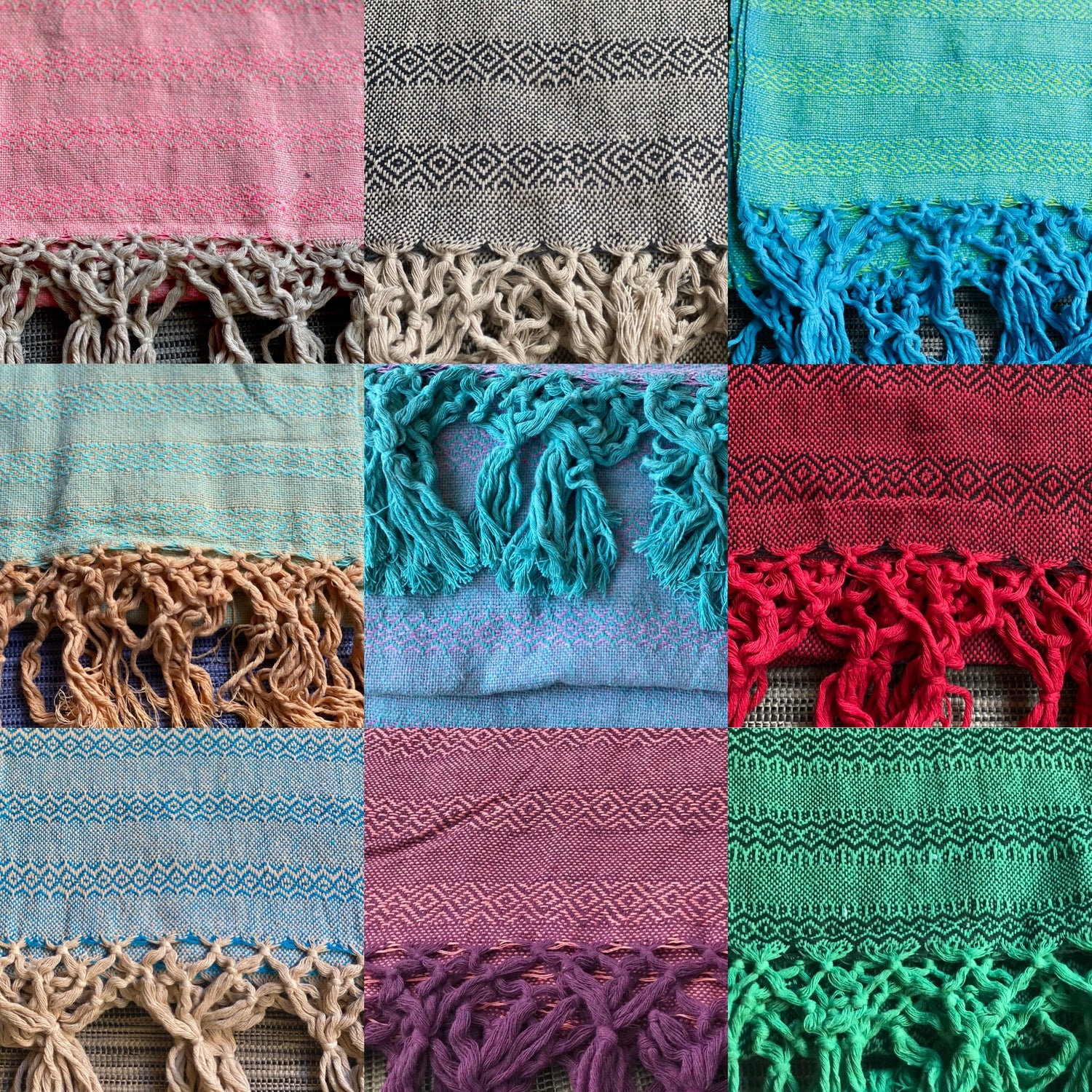
Our rebozos are handwoven in Mexico by local artisans on a foot-pedal loom, in cotton. They're about 60 cm (23") wide, with hand-knotted fringe, and come in lengths from 2 m (78") to 3 m (118"). A 2 m length is enough for a loose neck drape, a loop, or a front or side knot. A 2.5 m (98") or 3 m (118") length gives you more fabric for a double wrap or a fuller shoulder drape. You can browse our handwoven Mexican rebozos in our collection. One example is the Winter Awakening cotton rebozo.
Six rebozo knots and drapes
1. The loose neck drape
A simple starting point, with no knot.
- Hold the rebozo at its midpoint and place that midpoint at the back of your neck. Leave the cloth unfolded for more coverage, or fold it in half lengthwise for a narrower line.
- Let both ends hang evenly down the front.
- Smooth the cloth so it sits flat at the neck, and let the fringe hang free at each end.
This drape works with a 2 m length and up. It's an easy everyday layer when you want the cloth on but not tied.
2. The loop-through
A secure scarf tie that uses the cloth's own loop instead of a knot.
- Fold the rebozo in half so the two short ends meet. You should have a loop at the fold and two loose ends in your hand.
- Place the loop at the front of your neck and bring the loose ends around the back, then forward again.
- Pull the two loose ends through the loop.
- Slide the loop until the cloth sits close, but not tight. You should be able to slip two fingers between the cloth and your throat. Let the fringe hang below the loop, not through it.
A 2 m length can work; a 2.5 m length is roomier. This is a modern scarf tie, useful when you want the ends held in place.
3. The front knot
- Drape the rebozo over both shoulders so both ends hang down in front. Line the ends up, or leave one a little longer if you want an uneven finish.
- Tie a single loose knot at the center of your chest, low enough that it does not press against your throat.
- Tug each end gently so the knot sits flat, and keep the fringe out of the knot so it hangs clean.
This is the everyday chest knot. For waist knots and other styles, see the one-shoulder section below.
4. The side knot
- Start as you would for the front knot, with the rebozo over both shoulders and the ends hanging in front.
- Slide both ends toward one shoulder.
- Tie a single loose knot at the side of your neck, or just below the shoulder, and let the fringe hang free.
The side knot sits off-center, so one side of the chest stays clearer. Don't pull it tight against the neck.
5. The double wrap
This one uses more length.
- Hold one end at your chest with one hand.
- Wrap the long remainder twice around your neck, keeping the wraps flat and slightly loose.
- Join the working end to the short end with a loose knot, or tuck the working end under the wraps.
- Check that you can still slip two fingers under the cloth at your throat, and that the fringe is not trapped in the wraps.
A 2.5 m or 3 m length is more comfortable here than a 2 m length. If you run out of cloth before the second wrap sits smoothly, switch to the loop-through or the front knot.
6. The one-shoulder drape
A clothing drape only, not a way to carry a child.
- Place the midpoint of the rebozo on one shoulder, so one end hangs down the front and the other down the back.
- Bring the back end around your side to the front, at the opposite hip.
- Tie the two ends together in a loose knot at the hip, or tuck the back end under the front end if you prefer no knot.
- Adjust the cloth on the shoulder so it lies flat and the fringe hangs free.
A 2.5 m or 3 m length gives you more ease at the hip. If you want shawl, waist, pareo, or skirt-style looks instead, see more ways to drape and style a rebozo.
Tips for a clean tie
- Leave a little space at your throat. The cloth should sit close, not tight.
- Keep the fringe out of the knot so it hangs clean and is easier to untie.
- If a tie feels unstable, take it off and start again rather than pulling harder.
- After you wear it, see how to wash and store a rebozo.
This is not a baby carrier
The six ties above are for wearing the cloth as clothing. They are not instructions for carrying a child, and they are not a safety method. If you want to carry a baby in a rebozo, learn that skill from a trained person and read our guide to babywearing with a rebozo.
FAQ
What's the easiest way to tie a rebozo around the neck?
Start with the loose neck drape if you want no knot, or the loop-through if you want the ends held in place. Both work with a 2 m length.
What length do I need for these ties?
A 2 m (78") rebozo is enough for the loose drape, the loop-through, and the front or side knot. A 2.5 m (98") or 3 m (118") length is more comfortable for the double wrap and the one-shoulder drape. All of the lengths above are about 60 cm (23") wide.
Can I wear a rebozo as a scarf without tying a knot?
Yes. Use the loose neck drape, or let the cloth fall over your shoulders and leave the ends hanging in front.
Are these ties a way to carry a baby?
No. These are clothing ties only. For carrying, see our guide to babywearing with a rebozo and learn the hold from a trained person.
How do I keep the fringe from tangling when I tie it?
Leave the fringe out of the knot or loop, and hang it straight when you take the rebozo off. If the fringe has already tangled, see how to wash and store a rebozo.
Sources: INPI, "Cómo ha sido el uso del rebozo en México" (2015).